
Navigating the Precipice: University of Balochistan Fights Structural and Financial Turbulence
QUETTA — The University of Balochistan (UOB), the oldest and largest public-sector higher education institution in the province, is facing an existential crossroads. Long celebrated as the academic backbone of the region, the premier university is currently grappling with deep structural deficits, acute financial distress, and recurring campus friction that have collectively threatened its core educational mission.
The Public Accounts Committee (PAC) of the Balochistan Assembly recently held high-level sessions led by Chairman Asghar Tareen to evaluate the university’s fiscal accounts and audit irregularities. The sessions revealed an alarming administrative blueprint marred by historic budget mismanagement, bringing the institution’s long-term sustainability into sharp focus.
The Economics of a Higher Education Crisis
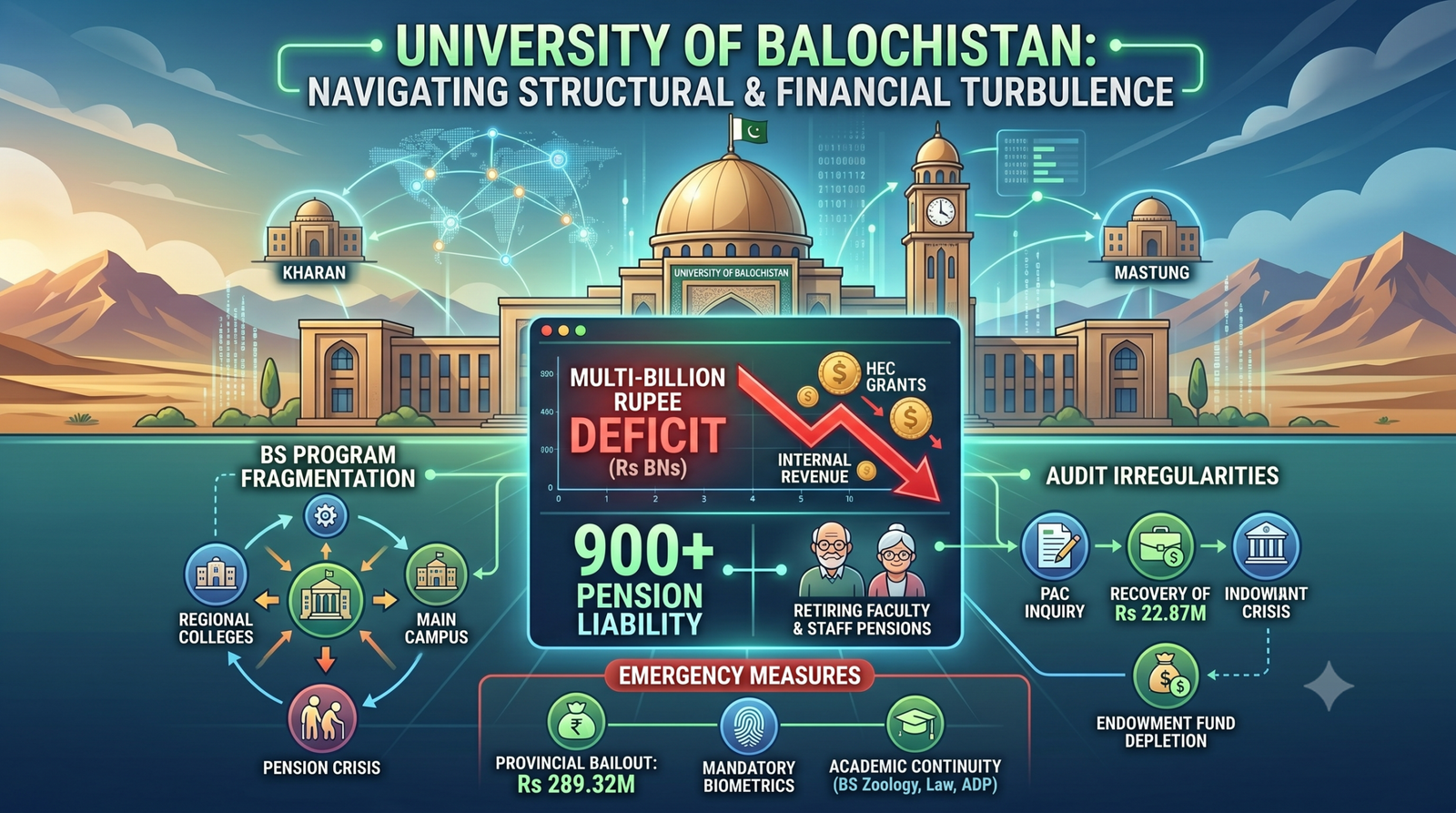
The primary crisis crippling UOB is an aggressive, multi-billion-rupee deficit. The university’s leadership, including Vice Chancellor Zahoor Ahmed Bazai, briefed the provincial legislature on severe shortfalls driven by a perfect storm of reduced federal funding and skyrocketing legacy costs.
[Declining HEC Grants] + [Drop in Main Campus Enrollments]
                              │
                              ▼
        [Severe Deficit & Inability to Pay Salaries]
                              │
                              ▼
        [Provincial Bailouts & Administrative Audits]
A significant portion of the university’s fiscal burden stems from its obligations to over 900 retired faculty and non-teaching staff who rely entirely on the institution’s pension system. Compounding this, the university’s internal revenue-generation mechanisms have been heavily diluted. The proliferation of decentralized BS programs in local regional colleges across the province has inadvertently pulled students away from the main Quetta campus, shrinking tuition-based cash inflows.
In a bid to stave off immediate operational collapse, the provincial government recently approved a special release of Rs289.32 million specifically earmarked to cover delayed salaries and immediate pension liabilities. While this capital injection offers short-term relief, auditors emphasize that ad-hoc provincial bailouts cannot replace a self-sustaining fiscal model.
Audits Uncover Historic Irregularities
The legislative review unsealed a series of previous administrative decisions that continue to drain current resources. The PAC flagged significant historical irregularities, including the controversial deployment of the university’s endowment funds to finance unqualified personnel for foreign degree programs—many of whom subsequently absconded overseas.
Furthermore, strict directives have been issued to recover millions of rupees in lost revenue due to unauthorized housing perks. The university has been ordered to immediately retrieve Rs22.87 million from residential employees who were mistakenly exempted from standard house rent allowances and maintenance deductions.
Student Realities and the Regional Footprint
Despite the financial gridlock, the academic machinery continues to operate across its expansive regional networks. The university management system has actively pushed out exam results and gazette notifications for its large cohorts across various sub-campuses and affiliated institutions, including:
-
BS Zoology programs at the Government Girls Degree College, Pishin.
-
Associate Degree Programs (ADP) across remote hubs such as Sui, Zehri, and Dera Allah Yar.
-
LL.B 5-Year Program annual examinations via the University Law College in Quetta.
| University Dimension | Current Operational Reality |
| Financial Backlog | Massive accumulated debt; reliance on emergency provincial grants |
| Pensioner Base | Over 900 retired personnel requiring regular payouts |
| Academic Scope | Spans main Quetta hub alongside vital sub-campuses like Kharan and Mastung |
| Compliance Focus | Mandatory biometric attendance; recovery of misallocated institutional assets |
To optimize administrative control amidst these tightening constraints, the university has implemented a strict mandatory biometric attendance system for all teaching and non-teaching cadres.
The Road Forward
The University of Balochistan remains an irreplaceable beacon of intellectual empowerment in a province desperately needing specialized human capital. However, the current landscape makes it clear that the university can no longer be managed through historical ad-hoc protocols.
Stabilizing UOB will require a structural overhaul: diversifying revenue through private-public partnerships, modernizing high-demand digital workflows, and resolving legacy administrative disputes transparently. Only by matching strict accountability with structural state backing can this historic institution safeguard the academic future of Balochistan’s youth.
