
Digital Renaissance: Pakistan’s Freelance Economy Surges Toward the Billion-Dollar Milestone
ISLAMABAD — Pakistan’s digital landscape is undergoing a massive structural transformation as its massive freelance economy emerges as a primary pillar of national foreign exchange. Driven by a tech-savvy youth bulge and increasing global demand for remote talent, the country’s independent digital workforce has transitioned from a localized trend into a vital macroeconomic powerhouse.
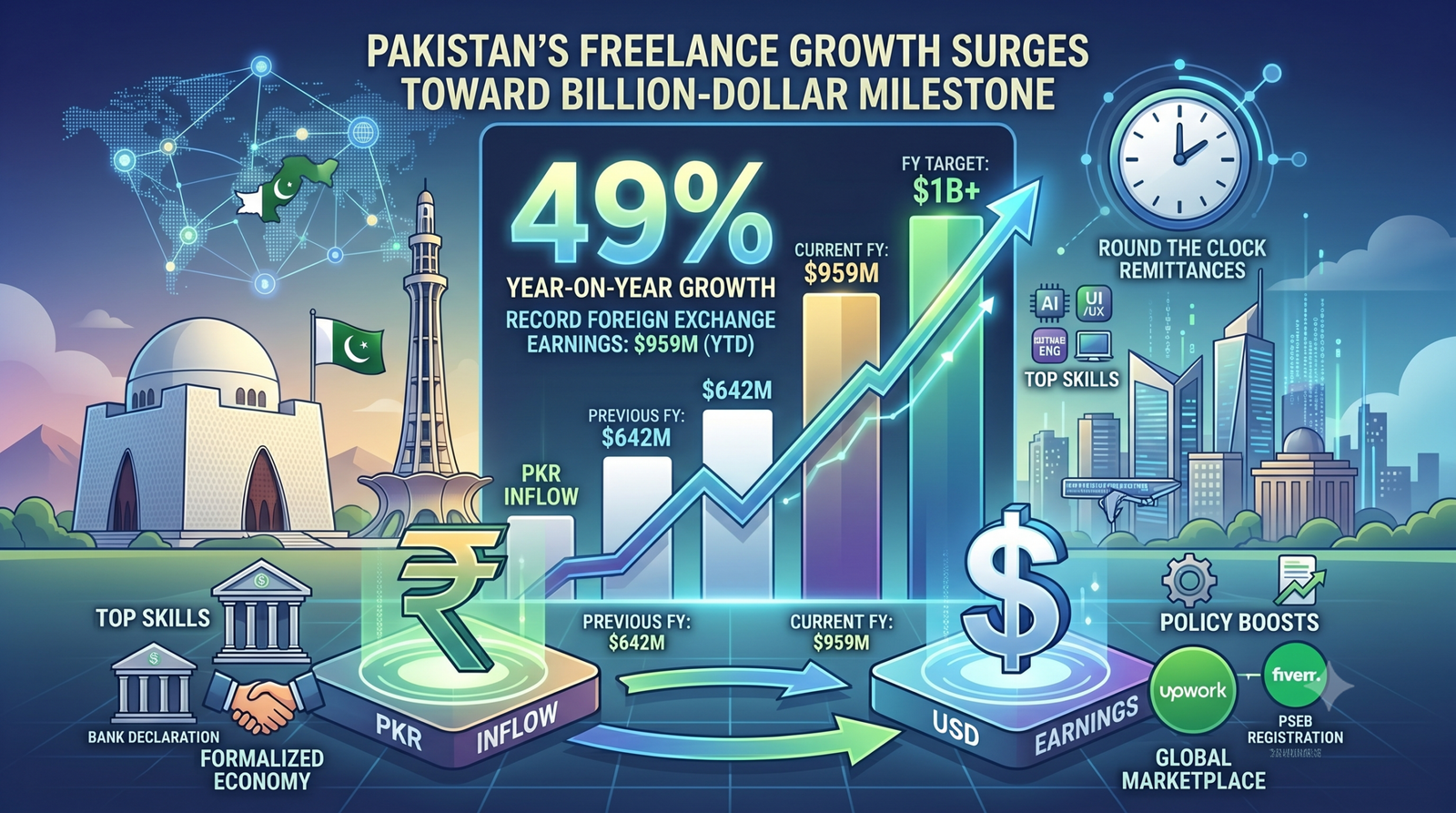
According to recent data from the State Bank of Pakistan (SBP) and the Pakistan Freelancers Association (PAFLA), Pakistani freelancers generated a staggering $959 million in foreign exchange earnings during the first ten months of the current fiscal year. This represents an astronomical 49% year-on-year growth compared to the $642 million recorded during the same period in the previous fiscal year, outperforming several regional competitors.
The Scale of Pakistan’s Gig Economy
With a population where over 60% of the demographic falls under the age of 30, Pakistan has rapidly scaled the global ranks of the gig economy. The country is currently home to an estimated 2.37 million to 3 million freelancers, solidifying its position among the top five largest freelancing hubs globally.
| Key Metric | Current Fiscal Year Performance |
| Total Inflow (First 10 Months) | $959 Million |
| Year-on-Year Growth Rate | 49% Increase |
| Estimated Digital Workforce | 2.5 – 3.0 Million Individuals |
| Global Ranking (Workforce Size) | Top 5 Globally |
The influx of foreign capital is no longer limited to traditional data-entry or basic administrative assistance. The current boom is anchored in high-value, skilled knowledge domains. Pakistani software engineers, mobile app developers, UI/UX designers, AI prompt engineers, and digital marketing strategists are commanding competitive dollar-denominated rates on global marketplaces like Upwork, Fiverr, and LinkedIn.
Proactive Policy Frameworks Driving the Surge
A significant catalyst behind this exponential growth is the structural facilitation provided by the financial sector and federal authorities. Recognizing the segment’s potential to ease balance-of-payments pressures, the State Bank of Pakistan introduced historic regulatory reforms designed to integrate digital workers into the formal economy.
Under these new directives, banks have abolished the restrictive “Form R” requirement for every individual transaction, replacing it with a simplified, one-time service declaration. Furthermore, freelancers registered with the Pakistan Software Export Board (PSEB) benefit from a highly subsidized tax regime of just 0.25%, alongside the legal authorization to retain up to 50% of their total dollar earnings in specialized foreign currency accounts.
Structural Bottlenecks and the Budget Debate
Despite the celebratory numbers, the freelance ecosystem faces significant infrastructure challenges. Periodic internet disruptions, submarine cable maintenance issues, and electricity load-shedding remain persistent hurdles for remote workers trying to maintain rigid international deadlines.
Additionally, as the government prepares to unveil its new federal budget, the freelance community has actively lobbied policymakers to extend the preferential tax exemptions. Industry experts warn that imposing standard income tax brackets prematurely could drive revenue back into informal gray channels like Hawala or Hundi, reversing years of formalization efforts.
The Horizon: From Gig Work to Tech Agencies
What began as a survival mechanism for thousands of young graduates facing local unemployment has evolved into a highly scalable economic engine. A noticeable macro-trend in the country is the transition of solo freelancers into micro-agencies and software startups, hiring local talent and compounding national export capacity.
As the fiscal year draws to a close, Pakistan’s freelance sector is definitively on track to cross the historic $1 billion annual revenue threshold for the first time. If the regulatory environment remains encouraging and infrastructure deficits are addressed, this decentralized digital workforce will continue to be a primary shield against national economic volatility.
Pakistan’s freelance economy made $950M in ten months provides an on-the-ground media look at how the country’s digital workforce is outperforming regional markets and pulling in record foreign exchange.
